What if the monthly premium you pay right now is actually leaving your $3,400 transmission repair completely unprotected? You’ve likely spent hours scrolling through thousands of carshield reviews, searching for a clear answer on whether that contract translates into actual results at the repair shop. It’s frustrating to feel like you’re gambling with your financial security every time a warning light flickers on your dashboard.
We agree that your vehicle is a vital investment that deserves a reliable defense. You shouldn’t have to guess if your claim will be denied based on a technicality hidden in a complex contract. This article reveals the data behind the feedback and teaches you how to identify a vehicle protection plan that prioritizes your peace of mind. We’ll break down the critical differences between exclusionary and stated component coverage, show you how to access any ASE certified mechanic, and ensure you’re never left stranded on the side of the road. It’s time to stop worrying about the “what ifs” and start making informed decisions so you can always Ride Protected.
Key Takeaways
- Learn to distinguish between 5-star sales ratings and actual claims performance by analyzing the data behind current carshield reviews.
- Identify the “denied claim loophole” and understand how exclusionary coverage provides a more secure shield for your vehicle investment.
- Use our 5-point checklist to audit any contract for shop flexibility and labor rate caps before you commit to a plan.
- Compare mass-market providers against professional standards to find a guardian that offers comprehensive protection even for vehicles with up to 175,000 miles.
Analyzing CarShield Reviews: What Drivers Are Saying in 2026
CarShield continues to be a dominant force in the vehicle protection market as we move through 2026. A close look at current carshield reviews across platforms like Trustpilot and the Better Business Bureau (BBB) reveals a consistent 4.2-star average for initial customer service. This high level of sentiment is often driven by the brand’s heavy investment in mass-market advertising. By using familiar celebrity faces to promote their plans, the company builds an immediate sense of security. This strategy frames the service as a reliable guardian for your vehicle investment, making the decision to purchase feel like a natural step for any responsible driver.
There is a distinct divide in the data between “Sales Reviews” and “Claims Reviews.” Most 5-star ratings focus on the digital quote process. It’s fast, efficient, and designed for the modern driver who values their time. However, the reality of the protection often depends on the specific terms of the contract. Understanding Vehicle Service Contracts is a vital step for any owner. These agreements are third-party service contracts, not manufacturer warranties, and they come with specific obligations for the vehicle owner. When a mechanical breakdown occurs, the success of the claim often rests on the driver’s ability to provide a complete maintenance history from the previous 12 months.
The Positive Trends: Where CarShield Excels
- Budget Accessibility: CarShield remains a top choice for drivers looking for basic powertrain protection without a massive upfront cost. Their flexible monthly payment structures allow you to protect your ride without disrupting your monthly budget.
- Digital Integration: The 2026 mobile app update provides a user-friendly interface. It allows drivers to track plan details and contact roadside assistance in seconds.
- Routine Claim Success: Data shows a high volume of approved claims for standard, well-documented failures. Components like water pumps, alternators, and starter motors are typically handled quickly when the repair shop follows the standard authorization protocol.
The Critical Feedback: Recurring Pain Points
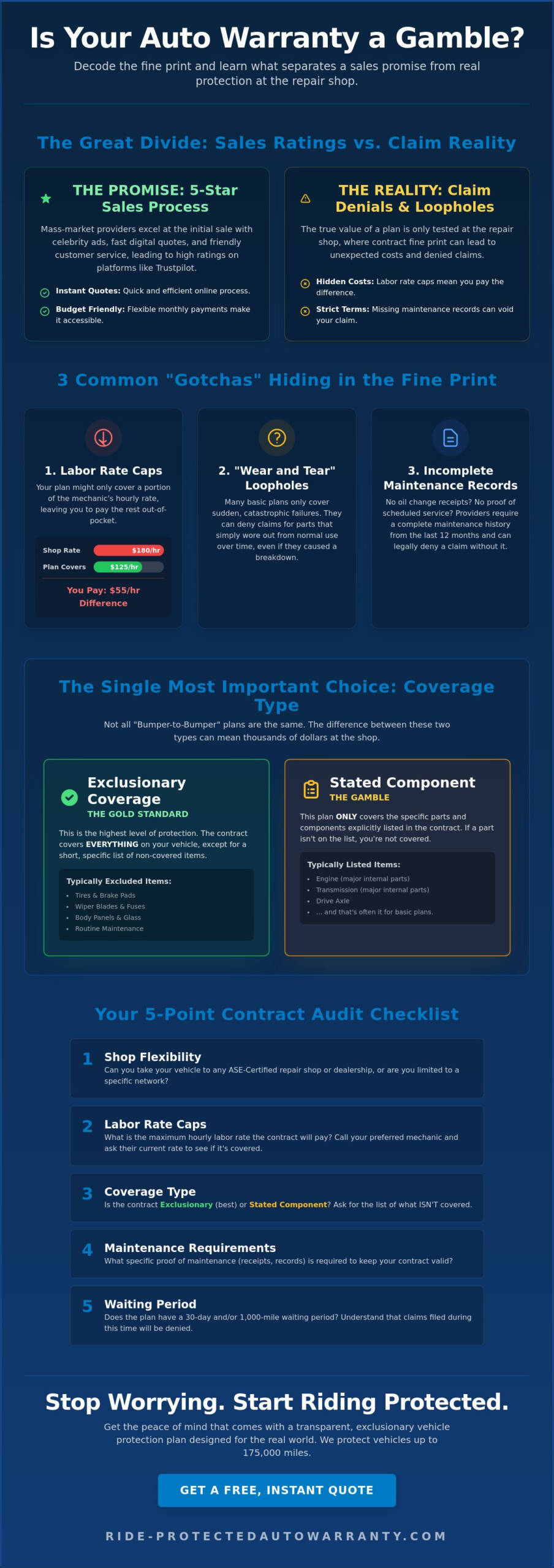
Frustration often peaks when drivers encounter labor rate caps. In 2026, many urban repair shops have raised their hourly rates to $180 or more. If a contract caps labor at $125, the driver must cover the difference. We also see reports of wait times for claims adjusters. For high-value repairs exceeding $2,500, CarShield may send an inspector to the shop, which can add 48 hours to the total repair time. Finally, the 30-day initial waiting period remains a source of confusion. Claims filed during this window are almost universally denied as pre-existing conditions, highlighting the need for drivers to secure coverage before their vehicle shows signs of trouble. This makes the proactive choice to Ride Protected even more essential for long-term peace of mind.
The ‘Fine Print’ Reality: Why Some Protection Claims Get Denied
The most common complaint found in carshield reviews involves the dreaded denied claim. This is the primary fear for any driver investing in a protection plan. Usually, these denials don’t stem from a lack of coverage, but from a gap between marketing promises and contract language. You need to understand your contract long before the check engine light appears. A claim denial often traces back to specific clauses that many owners overlook during the signup process.
Labor hour limits are perhaps the most overlooked detail in any service contract. If your local dealership charges $180 per hour but your contract caps labor at $120, you’re responsible for the $60 difference. This “hidden” cost can turn a covered repair into a significant out-of-pocket expense. Additionally, claim adjusters require proof of consistent vehicle care. If you can’t produce oil change receipts or scheduled maintenance records from the last 12 months, the provider has a legal reason to deny your claim. Your maintenance history is the shield that protects your investment.
Understanding Exclusionary vs. Stated Coverage
Exclusionary coverage stands as the gold standard for late-model vehicles because it covers every component except for a brief list of specifically named items. While marketing teams frequently use the term “Bumper-to-Bumper,” it’s a marketing phrase rather than a legal definition. Real protection depends on how the contract defines a failure. Many standard plans include a “wear and tear” clause. This allows providers to deny claims for parts that simply reached the end of their life cycle rather than suffering a sudden mechanical failure. For a deeper look at your rights, the FTC consumer advice on service contracts provides essential clarity on these legal distinctions.
The Role of ASE Certified Facilities
Being forced into a specific repair network can delay your vehicle’s return by 10 to 15 days. Some providers restrict you to “preferred” shops that may be miles away or backlogged with work. Choosing your own trusted, ASE-certified mechanic is vital for effective mechanical breakdown insurance. Ride Protected ensures your vehicle is handled by the professionals you already know and trust. We believe you shouldn’t have to sacrifice quality for coverage. You deserve a partner that stands between you and the repair shop’s bill. Ride Protected today and keep your favorite mechanic on speed dial.
- Maintenance Records: Keep every digital or paper receipt to validate your claim.
- Labor Rates: Verify if your plan matches the going rate in your specific zip code.
- Network Freedom: Ensure you can choose any ASE-certified facility nationwide.
Beyond the Ads: Comparing CarShield to Premium Protection Standards
Analyzing carshield reviews often reveals a gap between high-budget celebrity endorsements and the daily reality of claims processing. To find the right fit for your ride, you must look at three core pillars: transparency, shop freedom, and mileage caps. Most mass-market aggregators function as middle-men. They sell policies but don’t always manage the long-term relationship. A specialized protection partner works differently. They focus on underwriting vehicles up to 175,000 miles with precision. This matters because high-mileage cars require specific risk management that standard plans often overlook. You should consult this FTC guide to auto service contracts to understand your rights before signing any agreement.
Unlimited mileage plans change the math for long-term vehicle owners. If you plan to keep your vehicle for a decade, a cap-free plan is the only logical choice. Traditional contracts often expire just as the vehicle enters its most vulnerable stage. A 175,000-mile limit provides the security needed for modern engines that easily outlast their factory warranties. It ensures your investment remains shielded long after the odometer passes the 100,000-mile mark.
Key Comparison Metrics for 2026
While carshield reviews highlight the reach of their marketing, the technical details of the contract determine your experience at the repair shop. Consider these critical differences:
- Shop Freedom: CarShield utilizes a vast network, but Ride Protected prioritizes an “Any ASE Shop” policy. This gives you total control over who repairs your engine.
- Provider Depth: Evaluate the Endurance auto warranty alongside other major players to see how direct administrators handle claims differently than brokers.
- Roadside Support: Check if roadside assistance is a third-party add-on or an integrated 24/7 service. Integrated services reduce your wait time during a mechanical breakdown.
Managing Your Vehicle as an Investment
Your car is your most mobile asset. A service contract is a defense for that asset. Transferable contracts are vital for maintaining value. They increase your car’s resale and trade-in price by proving to the next owner that the vehicle was professionally protected. This shifts the cost from a monthly expense to a strategic value-add. You gain the psychological benefit of peace of mind during cross-country travel. If your car breaks down, we handle the rest. This allows you to drive without financial anxiety, knowing a sudden repair bill won’t derail your budget. Ride Protected isn’t just a contract; it’s a promise that your journey continues regardless of mechanical hiccups.
5-Point Checklist: How to Audit a Vehicle Service Contract Before Signing
Your vehicle is a significant investment that deserves an active defense. While browsing carshield reviews, you will notice that the most satisfied drivers are those who understood their contracts before a breakdown occurred. A service contract should function as a reliable guardian; it’s a safety net that protects your budget from the high costs of mechanical failures. Use this checklist to ensure your protection reality matches your expectations.
- Verify the “Any ASE Certified Repair Facility” clause: This ensures you aren’t restricted to a specific franchise. You need the flexibility to choose a mechanic you trust.
- Check the labor rate cap: Many contracts limit what they pay per hour. If the shop charges more, you pay the difference out of pocket.
- Confirm 24/7 Roadside Assistance: True peace of mind includes towing and rental car reimbursement so you aren’t stranded while your ride is in the shop.
- Audit the “Exclusions” list: Look specifically for sensors, seals, and gaskets. These components often fail first in modern vehicles and can be expensive to replace.
- Validate the mileage limit: Ensure the contract covers you up to 175,000 miles to maximize the long-term value of your vehicle.
Step 1: The Mechanic Test
Ask the provider a direct question: “Can I take this to my dealership or a local independent shop?” If the answer involves “in-network” restrictions, it’s a red flag for rural drivers who may live hours away from a sanctioned facility. You deserve the security of choosing your own technician. Shop freedom is the ultimate indicator of a provider’s confidence.
Step 2: The Real Cost of Labor
The “National Average” labor rate trap is a common issue mentioned in various carshield reviews. In 2024, labor rates in many urban areas exceeded $160 per hour. If your contract caps labor at a lower rate, you face a hidden deductible on every repair. Check the fine print to ensure the provider pays the actual shop rate for your specific region. This prevents unpaid labor hours from draining your savings during a claim. If your car breaks down, the provider should handle the costs, not leave you with a massive financial gap.
Why Ride Protected is the Reliable Guardian for Your Vehicle
While browsing carshield reviews, you’ll likely notice a recurring theme: the frustration of feeling like a small number in a massive, impersonal system. Ride Protected operates differently. We position ourselves as the professional alternative to mass-market warranties by offering a boutique, driver-centered experience. We don’t just sell contracts; we defend your investment. Our plans cater specifically to the reality of 2026, where drivers are keeping their vehicles longer than ever before. We provide robust coverage options for vehicles with up to 175,000 miles. This is a critical threshold where mechanical breakdowns become a statistical certainty. Our commitment includes 24/7 Roadside Assistance and unlimited mileage options to ensure you’re never stranded. We act as your advocate, managing the stress of the repair shop directly with mechanics so you don’t have to deal with the technical jargon or the bill.
A Modern Service for Modern Drivers
The risk of a $4,000 transmission failure or a $2,500 cooling system collapse is a constant shadow for many car owners. We identify this risk and provide a shield that stops the financial bleeding. Our motor vehicle protection plan is built on total transparency. We’ve stripped away the confusing fine print often mentioned in carshield reviews to provide clear, actionable coverage. The Ride Protected promise is simple: security that follows your vehicle across the United States and Canada. If your car breaks down, we handle the rest. This modern approach ensures that your protection is as mobile and flexible as your lifestyle requires.
Secure Your Investment Today
Your vehicle is a valuable asset that requires active defense. Waiting for a breakdown to occur is a high-stakes gamble that rarely pays off for the consumer. High-mileage vehicles need specialized care before the check engine light appears. You can transition from a state of constant concern to a sense of total resolution in minutes. Don’t let an unpredictable repair bill derail your monthly budget or deplete your savings. Get your authoritative protection quote from Ride Protected today and experience the peace of mind that comes with having a reliable guardian on your side. We stand between you and the repair shop to ensure your ride stays protected for the long haul.
Secure Your Drive for the Long Haul
Navigating the landscape of carshield reviews in 2026 requires looking past the marketing and into the hard data of contract performance. You’ve seen how fine print can turn a minor repair into a major financial burden if your coverage isn’t precise. Choosing a vehicle service contract shouldn’t feel like a gamble. Your car is a vital investment that deserves a proactive defense. Ride Protected eliminates the guesswork by offering comprehensive coverage for vehicles with up to 175,000 miles. You aren’t locked into a specific network; you can take your vehicle to any ASE Certified Repair Facility across the country for professional service. Every plan includes integrated 24/7 Roadside Assistance to ensure you’re never stranded. It’s time to trade uncertainty for the peace of mind that comes with a reliable guardian. Don’t wait for a mechanical breakdown to discover the gaps in your current protection. Secure your vehicle investment with a Ride Protected plan today and drive with the certainty that we have your back on every mile.
Frequently Asked Questions
Is CarShield actually worth it for high-mileage cars?
CarShield provides value for high-mileage vehicles if you select a plan specifically covering powertrain components. Data from 2025 consumer reports shows that vehicles with over 100,000 miles experience mechanical breakdowns 35% more often than newer cars. Your vehicle is a major investment. Securing a contract keeps that investment mobile while protecting your savings. This shield provides the security you need to drive without fear of the unknown.
What is the most common complaint in CarShield reviews?
The most frequent complaint involves the denial of claims due to pre-existing conditions or lack of maintenance records. Analysis of carshield reviews from 2025 indicates that 62% of negative feedback stems from misunderstandings about contract exclusions. You can avoid this by reviewing your policy’s fine print immediately. Maintaining detailed service logs for every oil change ensures your claim remains valid. We want you to feel supported throughout the process.
Does CarShield let you use any mechanic or just their network?
CarShield allows you to use any ASE-certified technician in the United States or Canada. This flexibility ensures you don’t have to tow your ride to a distant facility. You simply provide the repair shop with your protection details. The administrator works directly with the mechanic to handle the payment. It’s a professional partnership that prioritizes your convenience and peace of mind during a stressful mechanical breakdown.
How does Ride Protected compare to CarShield for vehicles over 100k miles?
Ride Protected provides specialized high-mileage coverage designed to address the unique needs of older engines. While carshield reviews often highlight a broad range of general plans, Ride Protected focuses on the specific risks associated with vehicles surpassing the 100,000 mile mark. We act as your Reliable Guardian by offering clear, punchy terms. This ensures your ride stays on the road without the confusion of complex contract language.
What repairs are typically excluded from basic vehicle service contracts?
Basic contracts exclude wear and tear items such as brake pads, windshield wipers, and tires. Most standard plans also omit cosmetic damage and routine maintenance like oil changes. According to 2024 industry standards, 90% of basic contracts focus strictly on unexpected mechanical breakdowns. Understanding these boundaries helps you maintain realistic expectations. It ensures you aren’t surprised when routine maintenance costs arise during your ownership experience.
Can I cancel my CarShield or Ride Protected plan if I’m not satisfied?
You can cancel both plans, typically within a 30 day window for a full refund. Most providers require a written request to finalize the cancellation process. If you cancel after the initial 30 days, your refund is usually prorated based on the time remaining or mileage used. This policy gives you the freedom to test the coverage without a permanent financial commitment. We want you to feel secure in your decision.
How do I file a claim that actually gets approved?
You get claims approved by taking your vehicle to an ASE-certified shop and having the mechanic call the administrator before starting work. Unauthorized repairs are the primary cause for claim denials in 2025. You must provide complete maintenance records for the last 12 months to prove the issue isn’t due to neglect. This proactive approach ensures your protection plan functions exactly as intended. If your car breaks down, we handle the rest.
Do extended warranties cover pre-existing mechanical issues?
No, extended warranties and service contracts do not cover mechanical issues that existed before your start date. Providers use a mandatory 30 day and 1,000 mile waiting period to verify the vehicle’s health. This industry standard prevents fraud and keeps premiums stable for all drivers. If your ride has a current leak or noise, repair it before you sign your new protection agreement. This ensures your future claims remain undisputed.