A sudden engine failure in 2026 can leave you facing a $5,200 repair bill before the tow truck even arrives. It’s a terrifying reality for drivers who rely on their vehicle for work and family life every single day. You shouldn’t have to live in fear of a dashboard warning light or an unexpected $3,000 transmission failure. Your car is a vital investment. You deserve to feel secure every time you turn the key. We know that the confusion between standard auto policies and mechanical breakdown insurance often leaves owners vulnerable when they need help the most.
This guide explains how a dedicated protection plan shields your finances from the rising costs of labor and parts. You’ll learn how to lock in a fixed monthly cost that covers repairs at any ASE certified mechanic of your choice. We’ll compare standalone coverage against basic insurance add-ons to ensure your vehicle stays on the road for as long as you own it. It’s time to claim your peace of mind and Ride Protected.
Key Takeaways
- Learn how to transform your vehicle into a protected asset by shielding your budget from the unpredictable volatility of modern repair shops.
- Navigate the “Electrical Revolution” to ensure your vehicle’s complex sensors and infotainment modules are as defended as the engine and transmission.
- Discover whether your vehicle qualifies for mechanical breakdown insurance or if a specialized service contract provides the better shield for your specific mileage.
- Optimize your protection investment by applying a strategic approach to deductibles, ensuring you never face a mechanical failure alone.
- Secure your journey with the ASE advantage, giving you the freedom to utilize any certified repair facility for a truly worry-free driving experience.
What is Mechanical Breakdown Insurance and Why Does Your Investment Need It?
Mechanical breakdown insurance is a specialized policy designed to cover the failure of your vehicle’s mechanical and electrical components. It acts as a Reliable Guardian for your wallet, defending your budget against the volatility of modern repair shops. While your car is a vital tool for daily life, it’s also a significant financial investment that requires a proactive defense strategy. In 2026, vehicles are more complex than ever. They function as mobile data centers equipped with intricate LiDAR sensors, high-output CPUs, and advanced battery management systems. A single failure in these systems can lead to a repair bill exceeding $4,500, a figure that has risen 15% since 2023 due to specialized labor and part scarcity.
Choosing mechanical breakdown insurance ensures you aren’t left stranded when a component reaches its limit. It’s often compared to an extended warranty, providing a similar layer of security after the initial factory coverage expires. By securing this protection, you transform unpredictable repair costs into a manageable, fixed expense. This allows you to Ride Protected, knowing that if your engine or electrical grid fails, we’ve got the rest covered.
The Core Purpose of Mechanical Protection
MBI serves as the essential bridge between the expiration of a manufacturer’s warranty and the high risk of out-of-pocket financial disaster. For the daily commuter, this coverage provides the peace of mind needed to face a long drive without anxiety. Data from S&P Global Mobility shows the average age of vehicles on the road reached 12.5 years in 2023, and that number is projected to hit 13 years by 2026. Older vehicles are statistically more likely to suffer component fatigue, making a dedicated shield for your investment more critical than it was a decade ago.
MBI vs. Standard Auto Insurance
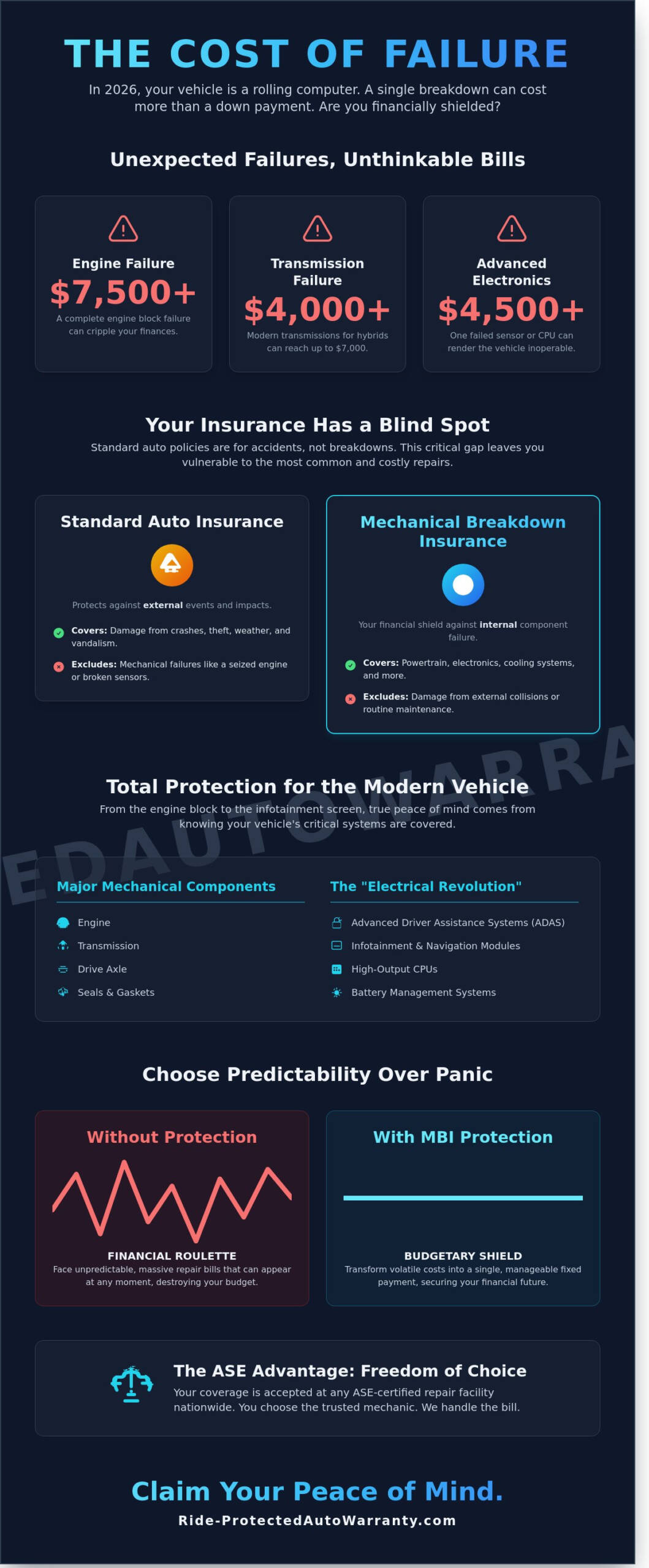
Standard auto insurance is designed to protect you from external impacts, but it won’t fix a blown transmission or a fried infotainment motherboard. You need different shields for different threats. While collision and comprehensive policies handle accidents and theft, mechanical breakdown insurance fills the specific gap left for internal failures. Consider these distinctions:
- Standard Insurance: Covers external damage from crashes, weather, or vandalism.
- Mechanical Breakdown Insurance: Covers internal failures like seized engines, failed cooling systems, or broken sensors.
- The Gap: Without MBI, a $7,000 transmission failure on a 2026 hybrid is entirely your responsibility, even if you have the best “full coverage” accident policy available.
By integrating both types of coverage, you create a total vehicle protection strategy. You ensure your ride remains a reliable asset rather than a financial liability.
What Does Mechanical Breakdown Insurance Cover? (And What It Doesn’t)
Understanding the specifics of your coverage ensures you aren’t left stranded by a sudden repair bill. Mechanical breakdown insurance acts as a financial barrier between your bank account and the repair shop. While every policy varies, the most robust plans focus on the vital parts that keep your ride moving safely. This protection isn’t just a safety net; it’s a strategy to preserve your vehicle investment against the rising costs of 2026 automotive technology.
Major Mechanical Components
The powertrain remains the heart of your vehicle. In 2026, internal combustion engines and hybrid power units are more complex than ever. A total engine block failure can now cost $7,500, while drive axle repairs often exceed $1,200. “Modern transmissions can cost upwards of $4,000 to replace, making protection a calculated investment rather than an expense.” Your policy should also include seal and gasket coverage. These small components prevent vital fluids from leaking and protect the engine from catastrophic failure. If a $20 seal fails and causes a $3,000 engine seizure, you need a plan that covers the resulting damage. You can find more details on how these agreements are structured in this official guide to vehicle protection plans.
Advanced Electronics and Technology
Vehicles are now computers on wheels. Modern mechanical breakdown insurance has evolved to cover the “Electrical Revolution.” This includes Advanced Driver Assistance Systems (ADAS) sensors, infotainment screens, and climate control modules. A single failed sensor in a 2026 safety suite can cost $1,500 to calibrate and replace. These aren’t just luxury features; they’re essential for safe operation. Specialized labor rates for electronic diagnostics now average $215 per hour in many major cities. Having a comprehensive protection plan ensures these high-tech failures don’t derail your monthly budget.
Common exclusions typically include:
- Routine Maintenance: Oil changes, filter replacements, and fluid top-offs.
- Wear-and-Tear Items: Tires, brake pads, windshield wipers, and light bulbs.
- Pre-existing Conditions: Issues that were present before the policy start date.
- Negligence: Damage caused by failing to follow the manufacturer’s service schedule.
It’s vital to remember that your coverage is a partnership. You handle the maintenance, and the provider handles the unexpected failures. This balance provides the peace of mind you need to enjoy the road ahead without financial anxiety.
MBI vs. Vehicle Service Contracts: Which Shield is Right for You?
Many drivers assume they’ve missed the window for protection. The most common objection heard in 2026 is, “I can’t get coverage because my car is five years old.” This frustration stems from the rigid rules of traditional mechanical breakdown insurance. While MBI offers a safety net, its entry requirements are notoriously narrow. If you don’t act within the first few months of ownership, the door often slams shut. Understanding the difference between a policy add-on and a standalone contract is the first step toward securing your investment.
The Insurance Add-on Limitation
Major carriers like Geico or Progressive typically require you to enroll a vehicle before it hits 15,000 miles or passes the 15 month mark. This creates a “lock-in” effect. If you want to keep your coverage, you’re forced to stay with that specific insurance provider regardless of their premium hikes. Switching your primary auto insurance means losing your mechanical breakdown insurance instantly. It leaves your investment vulnerable right when the factory warranty expires. You lose the freedom to shop for better rates because your repair shield is tied to your collision policy.
The Freedom of Standalone Protection Plans
Vehicle Service Contracts (VSCs) provide the flexibility that insurance companies lack. A VSC functions as a comprehensive shield for the rest of us. It offers a standalone plan that doesn’t depend on who handles your collision or liability coverage. Ride Protected covers vehicles with up to 175,000 miles on the odometer. This allows you to secure your ride long after the 15,000 mile insurance window has closed. These plans are specifically designed to adapt to your driving habits rather than forcing you into a rigid corporate box.
When evaluating these options, it’s vital to ask Is an Extended Warranty Right for You? as experts at AAA suggest. They note that these plans provide essential budget stability for unexpected repairs. Long-distance drivers benefit from “Unlimited Mileage” options that aren’t available through standard insurance add-ons. You gain a Reliable Guardian for your vehicle that stays with you. This protection remains active even if you change your car insurance every six months to save on premiums. It is a dedicated defense for your vehicle’s mechanical health.
- VSC Flexibility: Coverage available for cars up to 175,000 miles.
- MBI Limitation: Often restricted to cars under 15,000 miles.
- Portability: VSCs stay active even if you switch your primary insurance carrier.
- Customization: Choose terms that match your specific annual mileage.
Evaluating the Cost and ROI of Mechanical Protection
Investing in mechanical breakdown insurance isn’t just another monthly bill; it’s a strategic move for asset defense. Your vehicle is likely one of your largest investments, and protecting its functionality is vital. In 2026, coverage costs are determined by several specific data points that reflect your vehicle’s risk profile. Providers analyze the make, age, and mileage to set a baseline. For instance, luxury vehicles often see premiums 22% higher than economy models due to the specialized sensors and proprietary software required for repairs.
The “Deductible Strategy” is your primary lever for controlling costs. You can opt for a $0 deductible to ensure you never pay a cent at the repair shop, though this increases your monthly premium. Conversely, choosing a $250 or $500 deductible lowers your fixed monthly cost. This creates a balance between predictable monthly budgeting and the risk of a one-time out-of-pocket expense. Most drivers find that a single major claim covers three to five years of premiums. If your turbocharger fails, a common $2,800 repair in 2026, the plan effectively pays for itself in one afternoon.
Preserving Your Vehicle’s Resale Value
Documented protection makes a used car significantly more attractive to savvy buyers. When you can show a history of professional coverage, you remove the “fear of the unknown” for the next owner. Transferable contracts are a powerful tool in private sales. Data from 2025 shows that vehicles sold with a transferable protection plan closed for 14% more than those without. It frames your car as a verified asset rather than a liability waiting to happen.
Calculating the Peace of Mind Factor
The psychological benefit of a protection plan is immediate. You’re trading the anxiety of a potential $5,400 transmission failure for the certainty of a small, fixed payment. By 2026, the average cost of a major engine repair has outpaced inflation, making fixed-cost protection a logical financial move. If your car breaks down, we handle the rest, ensuring you stay on the road without draining your savings or taking on high-interest debt.
Get a personalized quote for mechanical breakdown insurance and drive with confidence.
Ride Protected: Securing Your Journey with Professional Grade Coverage
Your vehicle is likely your second largest financial commitment. Ride Protected operates on the Guardian philosophy, which treats your car as a vital investment rather than a disposable tool. We act as a professional shield between your savings and the rising costs of parts and labor. Securing mechanical breakdown insurance ensures that a failed transmission or a blown head gasket doesn’t derail your financial future. We provide the security you need to drive with confidence every single day. Our goal is to transform the stress of a breakdown into a managed, minor inconvenience.
The Freedom to Choose Your Mechanic
Many protection plans lock you into dealership repairs where labor rates in 2026 often exceed $215 per hour. We believe you should have the final say in who touches your engine. Our coverage works with any of the 400,000 ASE-certified technicians across the country. If you have a local shop you’ve trusted for a decade, you can keep going there. The claims process is designed for maximum efficiency. Our team coordinates directly with the service manager to authorize repairs and issue payment. You won’t have to navigate complex jargon or wait weeks for a reimbursement check. We handle the shop; you keep your ride.
Comprehensive Benefits Included
True protection extends far beyond the engine block. Every Ride Protected plan includes 24/7 Roadside Assistance to handle the unpredictable variables of the road. This includes towing services up to 50 miles, battery jump-starts, and professional lockout assistance. We also provide emergency fuel delivery if you run dry between exits. For the 45% of drivers who now commute more than 30 miles daily, our unlimited mileage promise offers a level of durability that standard warranties simply can’t match. This comprehensive approach to mechanical breakdown insurance removes the anxiety of being stranded in an unfamiliar area.
Don’t wait for a warning light to appear on your dashboard. You can get a customized quote in less than 60 seconds to protect your budget from the rising costs of automotive technology. Secure your vehicle’s future and Ride Protected today.
Secure Your Vehicle Investment for the Road Ahead
Your car is a significant financial asset. As repair costs are projected to rise significantly by 2026, leaving your investment to chance isn’t a viable strategy. Choosing mechanical breakdown insurance ensures that a sudden engine failure or transmission glitch won’t derail your monthly budget. You’ve seen how these plans offer a superior ROI compared to paying out of pocket for expensive parts and labor.
Ride Protected provides a professional grade shield for your journey. We offer comprehensive coverage for vehicles with up to 175,000 miles on the odometer, ensuring even high-mileage cars stay protected. You aren’t restricted to specific dealerships; you can take your vehicle to any ASE Certified Repair Facility in the country. Every plan we provide includes 24/7 Roadside Assistance to handle emergencies whenever they occur. It’s about more than just fixing parts; it’s about the peace of mind that comes from knowing you’re never alone on the road. For a deeper understanding of your options, explore our ultimate guide to motor vehicle protection plans in 2026 to make an informed decision about securing your automotive investment.
Defend your investment and get a free quote from Ride Protected today.
Drive with the confidence that your wallet and your ride are fully shielded for every mile of your journey.
Frequently Asked Questions
Is mechanical breakdown insurance the same as an extended warranty?
No, mechanical breakdown insurance is a regulated insurance policy while an extended warranty is a service contract. Insurance policies often provide stricter consumer protections under state law. Ride Protected offers MBI plans that typically cost 25 percent less than traditional dealer service contracts. This ensures your investment stays secure without the heavy markup found at local showrooms. You’ll get the same level of defense for a more competitive price point.
Can I get mechanical breakdown coverage for a car with over 100,000 miles?
Yes, you can secure coverage for vehicles with up to 150,000 miles on the odometer. While many providers stop at 100,000 miles, our high-mileage tiers protect older engines and transmissions. A 2018 model with 120,000 miles still represents a major investment. We provide the safety net you need to keep that vehicle on the road for another five years or 60,000 miles. You don’t have to trade in your car just to feel secure.
Does MBI cover routine maintenance like oil changes or brake pads?
No, MBI doesn’t cover routine maintenance items like oil changes, wiper blades, or brake pads. These are considered standard operating expenses for any vehicle owner. A typical brake job costs $400 per axle in 2026, which remains your responsibility; our plans focus on the catastrophic failures that break your budget. We step in when a $4,500 transmission failure or a $2,200 fuel pump issue threatens your financial security.
How much does mechanical breakdown insurance typically cost per month?
Most drivers pay between $35 and $85 per month for comprehensive mechanical breakdown insurance. Your specific rate depends on your vehicle’s make, model, and current mileage. A 2023 Ford F-150 might sit at the higher end of that scale due to complex parts. Choosing a higher deductible, such as $250, can lower your monthly premium by 15 percent. This makes protecting your ride affordable for every budget. To find the best value for your specific situation, consider getting quotes for auto protection from multiple providers to compare coverage options and pricing.
What happens if my car breaks down far from home?
You’ll receive immediate help through our 24/7 roadside assistance program if you’re stranded. If a covered breakdown occurs more than 100 miles from your home, our trip interruption benefit pays for your hotel and meals. We provide up to $200 per day for three days to cover these unexpected costs. You won’t have to worry about being stuck in a strange city with a massive repair bill and no place to sleep.
Can I choose my own mechanic with a Ride Protected plan?
Yes, you have the total freedom to choose any ASE-certified mechanic in the United States or Canada. We don’t lock you into a specific network of dealers. If you have a local shop you’ve trusted for 10 years, you can keep taking your car there. Your mechanic just needs to call our claims team to verify the repair. We pay the shop directly with a corporate credit card so you don’t pay out of pocket.
Is mechanical breakdown insurance worth it for a reliable car brand?
Yes, mechanical breakdown insurance is vital even for reliable brands because modern vehicle electronics are expensive to replace. A 2025 Lexus or Subaru is mechanically sound, but a single failed infotainment screen or advanced driver-assistance sensor can cost $3,200. Repair costs have risen by 12 percent annually over the last three years. This coverage provides peace of mind by ensuring a small electronic glitch doesn’t turn into a major financial setback. When considering your options, reviewing a comprehensive motor vehicle protection plan guide can help you understand the full scope of coverage available for today’s sophisticated vehicles.
How do I file a claim if my vehicle suffers a mechanical failure?
You should contact our claims department at 1-800-555-0199 or use the Ride Protected mobile app before the mechanic starts any repairs. The shop provides a diagnostic report and a cost estimate for the parts and labor. We authorize the covered repairs within 60 minutes in most cases. Once the work is finished, we pay the repair facility directly. You only pay your chosen deductible, which keeps your savings account intact.