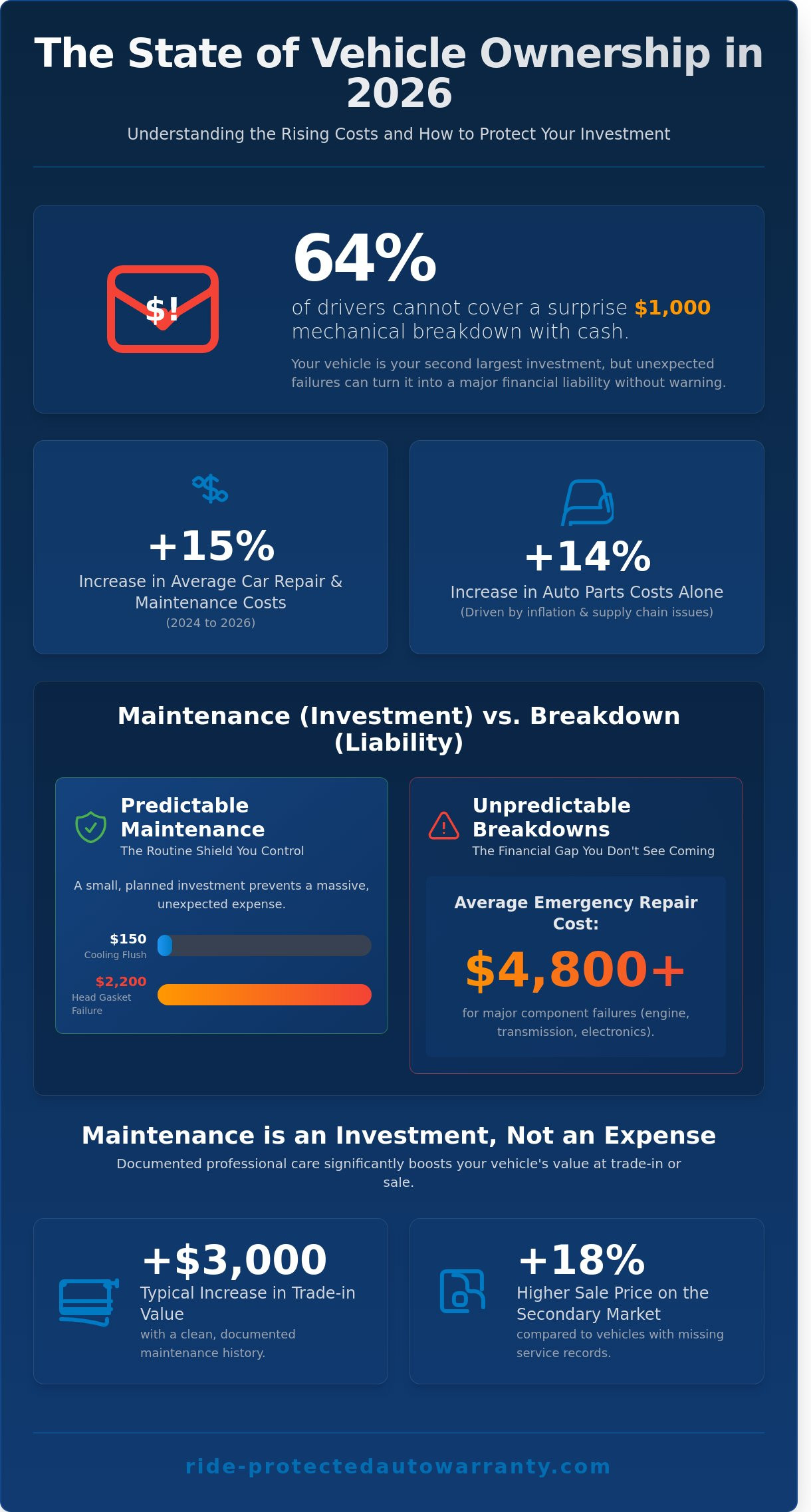
Did you know that 64% of drivers can’t cover a surprise $1,000 mechanical breakdown with cash? In 2026, the average cost for car repair and maintenance has climbed by 15% compared to just two years ago. Your vehicle is your second largest investment, but it often feels like a financial liability waiting to happen. It’s stressful when you can’t tell if a new noise is a minor fix or a budget-destroying catastrophe. You deserve a ride that offers security instead of constant worry about the next shop visit.
We believe that maintaining your car should be straightforward and predictable. This guide gives you the tools to master your vehicle upkeep, ensuring long term reliability and shielding your bank account from sudden failures. We’ll outline a precision maintenance schedule and reveal how documented care can increase your trade-in value by $3,000 or more. Read on to gain the clarity you need to drive with confidence and Ride Protected.
Key Takeaways
- Understand why evolving 2026 vehicle technology demands an active defense strategy to protect your automotive investment.
- Learn to navigate the financial impact of upkeep by distinguishing between routine car repair and maintenance and unpredictable mechanical breakdowns.
- Identify the importance of ASE certification and quality control to ensure your vehicle receives professional-grade care with national flexibility.
- Implement a strategic lifecycle checklist to keep your ride reliable as it progresses from 50,000 to 175,000 miles.
- Discover how to secure total peace of mind by layering professional maintenance with a comprehensive vehicle service contract.
Understanding the Landscape of Car Repair and Maintenance in 2026
Your vehicle is no longer just a way to get around; it’s a sophisticated mobile computer and a high-value asset that requires an active defense. In 2026, the average new car price has climbed past $51,000, making it one of the largest financial commitments in your portfolio. Advanced driver-assistance systems (ADAS) and complex electric drivetrains mean that professional care is no longer optional. You need a strategy to ensure your ride remains reliable and safe. This shift in technology means that DIY fixes are becoming rare, as specialized diagnostic tools are now mandatory for even basic tasks.
National safety standards now prioritize long-term structural integrity and frequent software updates. Following a structured motor vehicle service schedule ensures that these complex systems function correctly throughout the year. This proactive approach delivers the peace of mind you need to drive without the constant shadow of a potential breakdown. When you prioritize protection, you’re not just fixing a machine; you’re securing your mobility. You can’t afford to wait for a warning light to appear before you take action.
The True Cost of Vehicle Ownership
In 2026, the average driver spends $1,450 annually on upkeep, but emergency repairs often spike to $4,800 or more for major component failures. Inflation has driven parts costs up by 14% over the last two years, while supply chain constraints continue to lengthen repair times at local shops. If your car breaks down, the cost of a rental vehicle and lost time can double your total bill. The Total Cost of Ownership is the aggregate sum of a vehicle’s purchase price, financing, and depreciation, combined with the ongoing expenses of insurance, fuel, and active mechanical protection.
Why Maintenance is an Investment, Not an Expense
Viewing car repair and maintenance as an investment rather than a chore preserves your asset’s value for the long haul. A vehicle with a documented digital service history sells for 18% more than one with missing records on the secondary market. Beyond the numbers, there’s a psychological win. You feel more secure behind the wheel of a ride that’s been verified by professionals. It’s about being prepared for the road ahead. Documented care acts as a value-multiplier during trade-ins, proving to the next owner that the vehicle was never neglected.
- Prevents catastrophic engine or battery failure through early detection.
- Maintains factory-spec fuel efficiency to lower your monthly gas or charging costs.
- Secures higher trade-in values at dealerships by providing a clean bill of health.
- Ensures your safety systems and sensors are calibrated to current 2026 standards.
A well-maintained vehicle is a shield against financial anxiety. When you choose to Ride Protected, you’re making a calculated decision to defend your wallet from the unpredictable nature of mechanical wear. Don’t let a preventable failure derail your budget or your schedule.
Maintenance vs. Repair: Navigating the Financial Impact
Smart vehicle owners view car repair and maintenance as a dual-track financial strategy. The first track is the maintenance you control; the second is the repair you can’t. While regular service keeps your engine running, it isn’t a magic shield against mechanical fatigue. Even the most meticulously kept 2026 SUVs face component failure eventually. You need a plan that covers both the oil changes you schedule and the transmission failures you don’t. Your vehicle is a high-value investment that requires a defensive strategy to maintain its performance and resale value.
Predictable Maintenance: The Routine Shield
Routine tasks like swapping filters, rotating tires, and flushing fluids are the foundation of vehicle health. For a 2026 model, standard service intervals often stretch to 10,000 miles thanks to advanced synthetic lubricants. Older high-mileage cars still require more frequent 5,000-mile checks to stay viable. Neglecting these basics creates a cascading effect. A $150 cooling system flush prevents a $2,200 head gasket failure. To better understand your rights during these service visits, consult the FTC Auto Repair Guide for foundational advice on estimates and shop selection. Deferred maintenance is the fastest way to turn a reliable asset into a liability. It’s a choice that costs thousands in the long run.
Unpredictable Breakdowns: The Financial Gap
Perfect maintenance records don’t stop electronics from failing. Modern vehicles are computers on wheels. In early 2026, data indicates that a single faulty oxygen sensor or Engine Control Unit (ECU) can cost between $800 and $1,500 to replace. These aren’t wear items; they’re sudden, unpredictable failures. Vehicles enter the “Critical Failure Zone” between 75,000 and 175,000 miles. During this window, the probability of a major mechanical breakdown increases by 42% compared to the first 30,000 miles. You can learn more about bridging this gap in our guide on Mechanical Breakdown Insurance: Protecting Your Vehicle Investment in 2026.
High-mileage vehicles require a defensive financial posture. Industry reports show that repair costs for cars over 100,000 miles average $1,200 annually in 2026. You can’t avoid these costs entirely, but you can manage them. Setting aside a dedicated fund or securing a protection plan ensures your ride stays on the road without draining your savings. If you want to protect your investment today, start by separating your maintenance budget from your emergency repair reserve. This clarity provides the peace of mind every driver deserves when they hit the road.
Evaluating Your Repair Strategy: ASE Certification and Quality Control
Your vehicle is a significant investment. You shouldn’t leave its health to chance. In 2026, modern cars operate with over 100 million lines of code. This digital complexity makes professional car repair and maintenance a highly specialized field. ASE (Automotive Service Excellence) certification is the primary defense for your ride. It proves a technician has the verified skills to handle your vehicle safely. Without this gold standard, you risk your safety and your wallet on unverified labor.
The Anatomy of an ASE-Certified Facility
To earn ASE status, a technician must document 2 years of relevant work experience and pass a series of specialty exams. Only 67% of test-takers pass these rigorous exams on their first attempt. Quality facilities often adhere to the Automotive Service Association Standards to ensure ethical business practices and technical transparency. If a shop lacks these credentials, it is a major red flag. Non-certified shops often use outdated tools that cannot communicate with 2026 onboard systems. This leads to misdiagnosis and higher costs for you. A certified shop provides the technical expertise required for a valid vehicle service contract claim. Key indicators of a high-quality facility include:
- Advanced Diagnostics: Use of scanners costing upwards of $15,000 to interface with vehicle CPUs.
- Documented Procedures: A structured 10-step diagnostic process that prevents “parts-cannon” repairs.
- Credential Transparency: Current ASE patches and certificates displayed openly for consumer review.
National Flexibility: Repairing Your Ride Anywhere
One of the biggest mistakes owners make is feeling tethered to a single dealership. You deserve the freedom to choose your repair facility. National repair flexibility means you can visit any of the 30,000 ASE-certified shops across the United States. This is vital if you relocate or travel frequently. Statistics show that 33% of mechanical breakdowns occur more than 50 miles from the driver’s home. When your ride needs help, you need a network that follows you. Professional protection plans include 24/7 roadside assistance to bridge the gap between a breakdown and a certified repair. This safety net ensures you never face a $200 towing bill alone. It provides the peace of mind that comes with knowing you can Ride Protected regardless of your zip code. Certified repairs also streamline the claims process. Claims adjusters prioritize reports from ASE-certified facilities because they provide the technical clarity needed for rapid approval. Choosing the right shop isn’t just about the fix. It’s about securing your financial protection and ensuring your car repair and maintenance needs are met with precision.
The Lifecycle Management Checklist: From 50k to 175k Miles
Your vehicle is a 4,000-pound investment that requires a defensive strategy as it ages. Between 50,000 and 175,000 miles, the risk of a major mechanical failure increases by 42% based on 2025 industry claim data. Mastering car repair and maintenance during this window ensures you aren’t blindsided by a $4,800 transmission overhaul or a $2,500 suspension rebuild. Follow these steps to maintain control over your ride’s longevity.
- Step 1: The Baseline Inspection. At 50,000 miles, commission a comprehensive multi-point inspection. This identifies weeping gaskets or worn bushings before they graduate into catastrophic failures.
- Step 2: Sync Your Protection. Align your manufacturer’s service schedule with a vehicle service contract. This creates a seamless transition where routine fluid swaps and mechanical coverage work in tandem.
- Step 3: Monitor Critical Systems. By 90,000 miles, components like timing chains and cooling system plastics become vulnerable. These parts don’t always give a warning before failing, so proactive replacement is your best defense.
- Step 4: Document for Value. Keep a digital folder of every oil change and brake pad swap. Vehicles with verified service histories command a 15% higher trade-in value on the 2026 secondary market.
- Step 5: Lock in a Safety Net. Secure a mechanical breakdown plan before your odometer hits the 175,000-mile mark. Most comprehensive coverage options become restricted or significantly more expensive after this threshold.
The High-Mileage Transition (100k+ Miles)
Once your odometer crosses six figures, engine components face increased thermal stress and friction. This is the era where unlimited mileage plans prove their worth, providing a permanent shield against the rising costs of car repair and maintenance. If a repair estimate exceeds 65% of your vehicle’s current market value, having a protection plan ensures you don’t have to choose between a massive repair bill and losing your mobility.
Roadside Preparedness and Emergency Protocols
Modern road safety in 2026 demands more than just a spare tire. Keep a portable lithium-ion jump starter and a high-visibility safety kit in your trunk at all times. If your vehicle loses power, move to the shoulder immediately and stay inside the cabin. Use your 24/7 roadside assistance app to dispatch a tow; it’s the fastest way to get your ride to a certified technician without paying out-of-pocket for emergency hauling. The first 30 minutes of a breakdown are the most dangerous, so prioritize visibility and professional recovery services.
Don’t leave your journey to chance. Secure your vehicle investment today and drive with total peace of mind.
Securing Your Ride: The Role of Mechanical Breakdown Protection
Your vehicle is one of the most significant assets you own. Treating it as a static expense is a mistake; it’s a dynamic investment that requires active defense. While routine car repair and maintenance keeps your engine running, a mechanical breakdown protection plan ensures that a single part failure won’t derail your financial stability. Ride Protected acts as your Reliable Guardian, standing between you and the rising costs of automotive technology. In 2026, a sophisticated sensor array or a drivetrain failure can result in unexpected shop visits that cost thousands. We provide the safety net you need to drive with confidence.
Professional maintenance and vehicle service contracts work in total synergy. When you follow your manufacturer’s service schedule, you minimize wear. When the unexpected happens anyway, Ride Protected steps in. This combination creates a 360 degree shield for your ride. It’s about moving from a reactive mindset to a proactive strategy. If your car breaks down, we handle the logistics and the costs. You stay focused on your life while we manage the repair shop. This seamless integration of service and protection is the only way to ensure total peace of mind on the road.
Why a Protection Plan is a Modern Necessity
Sticker shock is a reality for drivers without coverage. A standard transmission replacement in 2026 now averages $5,400, while major engine work can easily climb past $9,000. These aren’t just numbers; they’re potential financial crises. Ride Protected replaces these volatile emergency bills with a predictable, low monthly cost. Our plans specifically support vehicles with up to 175,000 miles. This is critical because most factory warranties expire long before a car reaches its mid-life peak. We fill that gap, ensuring your high mileage vehicle remains a reliable asset rather than a liability. When evaluating protection providers, it’s essential to research their track record thoroughly. For example, examining Carguard warranties Google reviews can provide valuable insights into how different companies handle claims and customer service during critical moments. For comprehensive guidance on selecting the right coverage for your specific needs, our detailed motor vehicle protection plan guide for 2026 breaks down everything you need to know about securing your automotive investment.
Maximizing Trade-In Value with Ride Protected
Your protection plan serves you even when you’re ready for an upgrade. A documented history of car repair and maintenance combined with a transferable service contract is a powerful selling point. Buyers pay a premium for verified peace of mind. Industry data indicates that vehicles sold with active service contracts can see a 15% increase in private sale value. Our Vehicle Trade-in Services further assist this transition, helping you move from your current ride to your next investment with zero friction. It’s a complete lifecycle solution for the modern driver.
Don’t leave your financial security to chance. Finalize your 2026 protection strategy today. Secure your vehicle investment with a Ride Protected plan today and experience the road without the worry. Ride Protected is more than a contract; it’s your promise of a clear path ahead.
Take Control of Your Vehicle’s Future Today
Your vehicle is a major investment that deserves a high level of defense. Mastering car repair and maintenance in 2026 means moving beyond simple oil changes to a full lifecycle management strategy. We’ve explored how to maintain performance from 50,000 miles through 175,000 miles while ensuring quality through ASE Certified technicians. These steps turn a standard mode of transport into a reliable asset that lasts. Don’t let the high costs of modern technology catch you off guard.
Unexpected mechanical failures don’t have to cause financial anxiety. You can secure your ride with coverage that protects vehicles up to 175,000 miles. Every plan includes 24/7 Roadside Assistance and is honored at any ASE Certified Repair Facility nationwide. This proactive shield handles the stress of the repair shop so you don’t have to. It’s the most efficient way to ensure your driving experience remains worry-free and your budget stays intact.
Get a free quote for Mechanical Breakdown Protection and drive with peace of mind
The road ahead is unpredictable, but your repair costs shouldn’t be. Protect your investment today and enjoy the journey with total confidence.
Frequently Asked Questions
What is the difference between car maintenance and car repair?
Car maintenance involves proactive services like oil changes and fluid flushes to prevent issues, while car repair addresses components that have already failed. Routine car repair and maintenance is the best way to avoid a $4,000 engine replacement. By following your owner’s manual, you defend your investment against premature wear. Repairs are the reactive fixes required when a mechanical breakdown occurs and your ride is sidelined.
Can I use any mechanic for repairs covered by a vehicle service contract?
You can choose any ASE-certified repair facility in the United States or Canada for repairs covered by your vehicle service contract. This flexibility ensures you aren’t restricted to a single dealership. If a mechanical breakdown happens away from home, you simply take your ride to a licensed professional. We handle the claims process directly with the shop so you can get back on the road quickly.
Is it worth maintaining a car with over 150,000 miles?
Maintaining a vehicle with over 150,000 miles is highly cost-effective compared to the $725 average monthly payment for a new 2026 model. Modern engines can last 250,000 miles if you prioritize consistent car repair and maintenance. Investing $1,500 in annual upkeep is smarter than taking on $40,000 in new debt. Your high-mileage ride remains a reliable asset when you defend it with a proactive protection plan.
Does a vehicle service contract cover routine oil changes and tires?
Standard vehicle service contracts don’t cover routine oil changes or tires because these are considered wear-and-tear items. Most plans focus on major mechanical failures like transmission or engine issues. However, specific maintenance add-ons can cover these costs to help you manage your budget. Review your contract details to see if your plan includes a $50 credit for your next scheduled service or specific roadside assistance benefits.
How much should I budget for car repair and maintenance annually in 2026?
You should budget between $1,200 and $1,800 annually for vehicle upkeep in 2026. Labor rates at many shops now exceed $165 per hour, and parts costs have risen 15 percent since 2023. Setting aside $150 per month creates a necessary safety net for unexpected issues. A protection plan helps cap these costs by covering major repairs with a small, predictable deductible, giving you total peace of mind.
What happens if my car breaks down and I have an unlimited mileage plan?
If your car breaks down under an unlimited mileage plan, your coverage remains active regardless of the number on your odometer. These plans provide total security for long-distance drivers who exceed the 12,000 miles driven by the average American annually. You simply call for roadside assistance and your plan handles the mechanical breakdown costs. Your protection stays in place as long as the contract period is active.
Why is ASE certification important when choosing a repair shop?
ASE certification is important because it proves a mechanic has met the rigorous standards set by the National Institute for Automotive Service Excellence. Only 67 percent of technicians pass these exams on their first attempt, so it’s a clear marker of professional skill. Choosing a certified shop ensures your investment is in expert hands. Most protection plans require ASE-certified technicians to guarantee the quality of every repair performed on your ride.
Can a protection plan help increase my car’s trade-in value?
A transferable protection plan can increase your car’s trade-in value by $500 to $1,000. Potential buyers and dealerships pay more for a vehicle that has a documented history of professional care and active coverage. It transforms your ride into a lower-risk purchase for the next owner. This added security makes your investment more attractive in a competitive resale market, ensuring you Ride Protected until the day you sell.